Now we are back from our holidays, G is doing a great deal of training for his half-ironman race in September. This mainly involves getting up well before 6am on Saturdays and Sundays and going on a three to four hour bike ride out into Essex, then coming home and heading out for a run or a swim in Victoria Park. The rest of the day is then spent eating bananas and dozing under a quilt.So I've been thinking of good lone-parent things for me to do with the children while G is training or asleep. This week I asked C and O what they would like to do at the weekend. I vetoed a request to go to Kidspace in Romford (look at the link and you will understand why) and then a plea for an all day Wii tournament.Once C and O realised that the phrase 'anything you like' should actually be 'anything you like that Mum will like too' they came up with two great suggestions that really surprised me.C wanted to go to Kew Gardens for the day and O wanted to spend a morning doing science experiments.Despite being over the far side of London, we go to Kew fairly often. I love Kew but assumed that the children merely endured it. I was so pleased to find out that I was wrong!We saw:- beautiful, waxy waterlillies
- a flowerbed full of pineapples
- and a very self-satisfied peacock.


We took crayons and sketchbooks along and were pleased to find we had vivid enough colours to do the peacock justice.
 And a visit to Kew proved even more alluring for G than a 90km bike ride. He postponed his training for a day and came along too!
 This morning we woke up to find G and his bike long gone. After breakfast we settled down to some science experiments. We had chosen three to do:
- A citrus fruit will float with its skin on, but sink when peeled. Is this true?
- Turning milk into plastic (an experiment suggested in this excellent book)
- Baking a cake using condensed tomato soup (an appalling suggestion from the 2008 Blue Peter annual, that C and O BEGGED me to do).
We did the citrus fruit experiment with a grapefruit and a lemon. Both floated very happily with their skin on and sunk immediately when they were peeled.
 And what are you going to do with a peeled grapefruit and lemon other than eat them?
 C and O both love eating anything really sour - they will eat segments of raw lemons with lip smacking enthusiasm. I can hardly bear to watch - ack!The turning milk into plastic experiment was more dramatic. This is what we did.
- We heated up half a jam-jar full of milk in a small pan until warm (not boiling).
- Next we added 2 tablespoons of vinegar to the warm milk. Cue loud howls about the disgusting smell!
- Then we strained the curdled milk through the foot of an old pair of tights suspended over the jam jar for ten minutes. We were left with lumpy bits of rubber-like resin. It felt a bit like playdough.
- We pressed the rubbery stuff into a cookie cutter, then un-molded it and left it to dry out on the windowsill.
 It looks a bit like raw Wensleydale cheese but it doesn't smell. The book says after two days it will have hardened into plastic. I am thinking we should have compressed it a bit more - it still seems quite crumbly. When it is dry, this plastic will be casein, which knitting needles are sometimes made of. Very cool.And then the cake. C was my chief helper for this one. O said she thought the whole idea was "completely gross" and went off to build a playmobil world for her Sylvanians.Once C and I started mixing the ingredients we were inclined to agree with her. The cake mix smelt utterly disgusting and was a very unappealing orange colour.It was your basic cake recipe: cream butter and sugar, beat in eggs, add flour and baking powder, mixed spice and raisins. Spoon into tin and bake. But we also had to put a whole can of condensed tomato soup in with the eggs. Ugh ugh ugh. The smell! The orangeness!C remarked that this was no longer a science experiment but a religious one. If this cake turned out to be edible it would be a miracle.
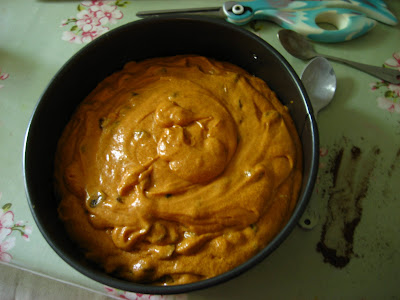 We baked the cake, and amazingly after about 20 minutes in the oven the kitchen started to smell rather good. When we took the cake out of the oven it had lost its alarming orangeness and was a dark brown - like a chocolate cake.
 We ate some (rather nervously) for lunch, and incredibly it tasted really rather good. O was not a fan, but she admitted that was because the whole concept of a cake made from soup was not really doing it for her. C on the other hand liked it so much he had a second slice!
We are going to give G a slice when he gets home, later this afternoon...will he guess what the secret ingredient is?


