Monday, 30 August 2010

A new approach to fruit gluts


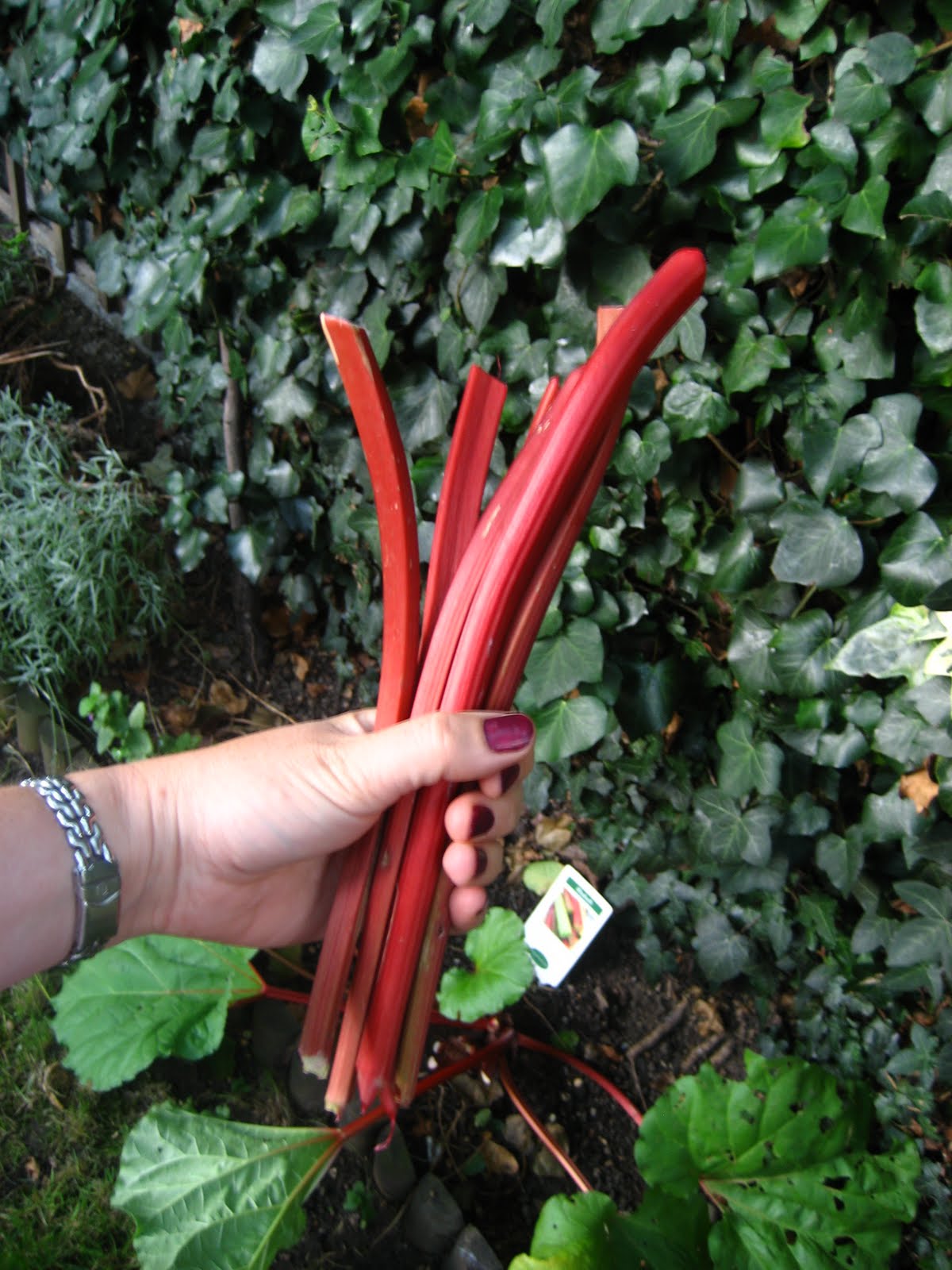
I have had a really good crop of rhubarb in my garden this summer.  I have been cutting big handfuls of stalks, like this one I cut last night, every couple of weeks.  There is not enough rhubarb here to call it a glut, but there are still many things I will do with it:
  • poached very briefly in orange juice, to eat with yogurt for breakfast
  • put into a cake - Nigella has plenty of recipes, and there is also this fantastic one from Driftwood that I have made several times
  • rhubarb and apple crumble
However, I have also been tackling proper fruit gluts this summer.  The branches on the plum trees at Mum & Dad's house were snapping under the weight of plums.

A glut of cherry plums in Mum & Dad's garden

And the wild hedgerow plum trees all through southern France were dropping plums and sweet juice all over the roadside.  When we went for walks we gathered and ate the plums as we walked.

Just look at the glee on their faces at yet more sweet plums!

Gathering greengages in my dress on an evening walk

Mum had already made several batches of jam before we arrived, and I had spent a few days making strawberry jam back in England, so our stocks of jam were already good.  And jam making is a slow, hot and sticky business when the weather is hot too. 

I saw a great range of these Le Parfait jars in the local supermarket and suddenly thought I might like to have a go at canning, or bottling, the plums.  Canning seems to be the word used in America, and bottling seems to be the word used in Britain, but they are exactly the same thing.  In France they use the word 'conserver' to describe everything from jam making to pickling of cornichons.  Like our umbrella term 'preserving'.

The internet gave me a million different methods of bottling fruit, and these varied wildly according to which country the instructions came from.  In the end we went with a method that was part various American YouTube tutorials and part a kind friend's emailed excerpts from the River Cottage Preserves Handbook.


This is what we did:
  • We halved and stoned the plums and put them into sterilised jars. 
  • We made a 50:50 sugar syrup, using 500g caster sugar and 500ml water, and when it was still hot poured this over the plums until it reached the mark at the top of the jars. 
  • Then we placed the first lid (the lid that seals the jar) lightly on top, and then partially screwed the second lid on top. 
  • To seal the jars you then have to heat them.  This is where I was most unsure of my method.  Some sources said to heat the jars in a water bath, some said to heat directly in the oven.  Times and temperatures varied wildly.  Hugh F-W said we could do either method, so we went with the water bath.
  • We put the jars of plums into a large pan, sitting them on a folded tea-towel.  Then we poured boiling water into the pan until it came half-way up the jars. 
  • The pan full of water and jars then went into a hot oven (gas mark 8) for forty minutes.
  • The jars were taken out and left to get completely cold overnight.  Then I checked that the first lid had completely sealed, and tightened the second lid.
The whole process was far quicker than making jam, and gives you fruit preserved in syrup, which can then be eaten with yogurt, cream or custard, and made into cakes or crumbles.


We learnt that we needed to pack the fruit in much, much tighter than we had done the first time, and that we could also use a much weaker sugar syrup.  175g of sugar to 600ml of water makes a good syrup that works on any type of fruit apart from the very sourest (such as damsons or gooseberries).

But even so the whole experiment was a great success.  We opened one jar a week later to try it out, and were swooning with delight at how tasty it was (nothing to do with the very sweet 50:50 sugar syrup, I'm sure).

Slightly obsessed by this point, I went on to bottle some tomato sauce.  The weekly markets always had incredible tomato stalls and one Sunday I succumbed to this enormous crate for €10 (which I then lugged around the crowded market, while C and O pretended not to know me).


I also bought a huge bunch of basil and a bag of garlic and shallots, and made industrial quantities of tomato and basil pasta sauce.  I spooned the hot sauce into the sterilised jars, put on the lids as I did for the plums, and then sealed them using the same water bath method.

And when we came to leave Mum and Dad's to drive to Switzerland, the car boot was half full of bottled plums and tomato & basil sauce.  I also brought back some more jars from the supermarket so that I can do some bottling at home, but if you want to have a go yourself you don't need to go to France for the jars and replacement inner (sealing) lids.  You can buy them online here and here.

This week I'm off to the PYO farm, because they still have plenty of summer berries and tomatoes for me to pick, and I still have a dozen empty jars waiting for me in the kitchen.

My fruit glut - ready to be put into the car and driven home, via Switzerland

Friday, 27 August 2010

Our summer adventure in numbers

C tries his first snails: "I can see why the hens love them so much!"
  • number of times son ate snails: 1
  • number of snails eaten: 6
  • his rating out of ten: 10
  • total miles driven: 2,448
  • days in France: 21
  • days in Switzerland: 8
  • number of strokes daughter could swim when she arrived in France: 0
  • number of continuous lengths she could swim when she left France: 26
  • number of long walks done: 5
  • longest distance walked: 12km
  • highest altitude walked: 2,021m
  • number of mornings I had a croissant for breakfast: 20
  • number of calories that adds up to: we won't dwell on that
  • photographs taken in France & Switzerland: 1,471
  • photographs uploaded to Flickr: 395
  • castles visited: 3
  • castle towers walked up by me: 0
  • glasses of wine drunk at the village fete: approx 3
  • glasses of muscat drunk at the village fete: not quite sure; perhaps 3
  • jars of plums bottled: 9
  • jars of fresh tomato and basil sauce bottled: 7
  • words of German that I understood on arrival in Switzerland: 3 - "Ein Bier, bitte"
  • words of German that I understood when I left: approx 23
  • number of times I actually said "Ein Bier, bitte": 0
  • number of times I used the car once I arrived in Switzerland: 0
  • number of funicular journeys: 2
  • number of train journeys: 6
  • number of bus trips: 4
  • number of tunnels I drove through: at least 65
  • number of precipitous viaducts I drove across: more than 100
  • highest altitude driven at: 2,210m
  • number of rostis eaten: 3
  • number of calories that adds up to: probably more than the croissants
  • number of borders crossed: 4
  • number of times our passports were checked: 1
  • amount in Swiss Francs it costs for a permit to drive on the motorway: 40
  • number of Logis hotels stayed at: 2
  • number of times I wished I'd had a satnav: 0
  • number of times I felt smug about travelling across Europe with just maps: 74
  • number of cowbells purchased by son: 2
  • euros I had left once I'd paid the last motorway toll at Calais: €0.21
  • books I took with me: 14
  • books read: 11 (bit too close for comfort)
  • hours it took us to locate our hotel in Nancy: 2
  • number of knitting shops visited: 2
  • number of sewing shops visited: 2
  • number of vide-greniers visited: 1
  • number of local markets visited: 5
  • number of visits to the extraordinary chocolate shop in Interlaken: 5
  • number of bears carved out of wood that daughter took photos of: 17
  • number of times I cooed over the view: at least 350
  • lazy home-based days we've had since we got back to London: 7
  • number of weeks left before school resumes: 1

Searing temperatures in Place Stanislas in Nancy

Happiness is a glass of chilled pink and a good book

The fairytale Schloss Oberhofen on Lake Thun

O at a funicular station above Interlaken

C heading down a mountain

C and O, with the Eiger, Monch and Jungfrau mountains in the background

Thursday, 15 July 2010

Summer break

Thank you all so much for the comments on the last post about the meat box.  It was a very interesting post to put together, and I am thinking of doing more frequent food and recipe posts later in the year.  Perhaps I will get an attack of nerdishness and share with you all my meal organisation plans.  Perhaps not!

But for now, the blog is taking a summer break.  We are off camping this weekend (at the wild campsite here), and then there are end-of-term excitements, a wedding, our trip to France and Switzerland, visits to the PYO and the blackberry woods, days out with friends, lazy days at home, and new adventures to be had in this great, big, mad city we live in - all before the children go back to school in September.

I shall continue to mutter about my days over on Twitter though, so you can follow me there should you be so inclined.  The link is over on the right had side of this page.

Happy summer, everyone!

Wednesday, 14 July 2010

A box of meat

I love good food, and I love cooking, but I do have a slightly uneasy relationship with cooking meat.

I didn't eat meat at all for nearly five years in my early twenties.  I just didn't enjoy the taste and texture of meat, and found that meals involving meat always revolved around the meat, rather than letting the other ingredients sing out.  So I stopped eating meat, got to know the world of vegetables and pulses, and was very happy. 

And then, aged twenty-six, I became pregnant, and suddenly with every fibre of my being, I craved meat.  I dreamed of lamb stews, sausages for breakfast, game terrine, chicken curries and pork pies.  I began to eat meat again, and re-discovered my taste for it.  I still eat meat now, eleven years on, and I enjoy eating it too.

But those years of not eating meat were the years when I really taught myself how to cook properly.  As a result, I find meat rather dull to cook with, and I always end up stocking the freezer with the same old cuts and feeling uninspired to try new recipes.  My best experiments usually seem to be the meat-free meals or the cakes and puddings. 

As a family we eat meat-free about half the time, which is fine by all of us, and fits in with the way of thinking, espoused most famously by Hugh F-W, that "Meat is the most precious of foods....It has its special status by virtue of being the flesh of animals, which must be killed in order to provide it." (River Cottage Everyday p.180).  I want to feel good about the meat I eat, and accord it the respect it deserves.  The meat I buy and eat does not necessarily have to be organic, but it does at least have to come from free-range animals that I know have been raised and slaughtered in a humane way.  So I buy my meat from the free-range selection at Waitrose, or from our local butcher, AG Dennis in Wanstead, who will tell me where the meat is from.  I eat less meat, so that I can afford to buy better quality meat.  But all this still does not get around the fact that I find meat so very uninspiring to cook with.  

One morning I had a moment of revelation as I was rambling on to someone about how wonderful our weekly vegetable box from Abel and Cole is for making me cook with ingredients I might not otherwise buy at the supermarket.  "Do you get a meatbox too?" my friend asked, and suddenly it seemed so obvious.

Abel and Cole do sell meat, and I have a regular order for their streaky bacon.  From time to time I also add other meats from them to my order.  However, they don't sell meat boxes and I am still guilty of ordering the same old familiar cuts of mince, diced lamb, chicken thighs and sausages from them.  I needed a meat box selected by someone else, which would introduce me to cuts of meat I wouldn't normally buy.

So I ordered a medium sized mixed meat box from Riverford Organic.  I winced at the price - £66.95 - but reminded myself that this was an experiment and if it proved to be poor value for money I didn't need to order it again.


My box came a month ago, and this is what the £66.95 bought me:
  • 600g braising steak (two large steaks)
  • 8 rashers unsmoked back bacon
  • a 1.2kg joint of boned pork loin
  • a ham hock (800g)
  • a large whole chicken (1.7kg), with giblets
  • 300g finely sliced cooked ham
  • 10 pork sausages
  • 400g diced pork
  • 600g minced beef
  • 1 mini black pudding (a complimentary taster)
All of this was organic.  When I unpacked the box, I was suprised just how much meat this was in reality.  I was relieved that I had cleared some space in the freezer in the few days before the delivery.  I had a happy afternoon sorting through everything, looking at use-by dates, working out what I was going to cook when, and what should go in the freezer, and finding recipes.  Out of this selection, the ham hock, pork loin and braising steaks were all new cuts to me; I had never cooked them before.

A month later, we have eaten everything in the box apart from the pork loin joint.  I would expect the pork loin to provide meat for three meals, so that would mean that the £66.95 has fed all four of us with meat for five weeks in total.  The only additional meat I have cooked in the last month has been four chicken thighs from Waitrose, and one pack of Abel and Cole's streaky bacon.

Here is my fabulously nerdy list of everything I cooked with all the different cuts of meat, and how many portions I got out of it all.
  • black pudding - two portions for Sunday breakfast, with roast tomatoes and toast.
  • sliced ham - sandwiches for eight, and part of a pasta sauce (with courgette, a little stock and creme fraiche) for four.
  • whole roasting chicken - four greedy portions as a roast dinner, four portions using  leftovers in a chicken and pepper fricasee, four further portions using leftovers in chicken and sweetcorn soup, and one final portion as part of a packed lunch.
  • I made two litres of chicken stock and chicken jelly from the giblets and the bones from the roast - this was used in the chicken and pepper fricasee, the chicken soup, the ham and courgette pasta sauce, and also in a pea risotto which made two portions.
  • back bacon - 5 rashers were used in a quiche lorraine, which fed six, and the remaining 3 rashers were made into a large BLT sandwich for one.
  • braising steak - I diced one of the steaks and made a mild beef curry, which fed four.  The other steak I cut into think strips and made a super-hot Hungarian goulash, which made six portions.
  • ham hock - I cooked the hock in coca cola, using Nigella's famous recipe.  The resulting ham fed four of us for supper with egg and oven chips.  The cold leftovers were then used over the next few days to make a sandwich for one, added to scrambled eggs for one, and stirred into couscous and spinach for four.
  • beef mince - I made this into a savoury beef and cheese crumble which made five portions.
  • diced pork - I made two four-portion pork, cider and mustard pies.  One for supper with new potatoes and one for the freezer.
  • sausages - I made a rich sausage and cider casserole which fed four of us (greedy portions - we all love sausages)
  • pork loin joint - not yet cooked, but hopefully to be roasted for four and then leftovers used for two further meals.  Probably a pie and a pasta sauce.
Assuming I get the twelve planned portions out of the pork loin, and discounting the portions from the chicken stock, I make this a grand total of 79 portions.  Meaning that each portion of organic meat works out at roughly 85p

I have loved cooking with all the unfamiliar cuts of meat, and searching out new recipes to use.  I have loved the taste and high quality of all the meat.  I have loved not having to think about shopping for meat for a whole month.  I also think that although the £66.95 is an alarming amount to pay for meat all in one go, it nevertheless represents very good value for money. 

I am planning on testing this out later in the summer by buying meat just from the local butcher and supermarket for a month and keeping a similar log of everything I buy and what I cook from it.  I am interested to see how much money I end up spending per portion, and how imaginative or otherwise my shopping and cooking will be.  I suspect I know the outcome already.

Friday, 9 July 2010

Ballet sewing

I don't know many people in real life who sew.  Sometimes I feel a bit of an oddball for doing so much sewing.  But there is one place I go to regularly where I fit right in, and where almost everyone knows about sewing.  O's ballet school.

Whether or not they knew anything about sewing when their daughters took up ballet, by the time their daughters have been there a few months, all the mothers have learnt to sew.

You start off by sewing elastic straps onto ballet shoes.  Not too taxing, but important to get right, so that the ballet shoes fit properly and the elastic doesn't ping off in the middle of an exercise thanks to lazy-mum sewing.  O gets through ballet shoes at the rate of two pairs a term, so that's many, many, many elastics sewn over the past four and a half years.

Sweet chubby legs wearing new shoes with new elastics - January 2007

Then the teachers will send the girls home with little bits of slippery silk, or satin, that need to be hemmed, or edged with lace, to become scarves or handkerchiefs or other dancing props.  Small girls learning ballet seem to do an awful lot of leaping about with floaty scarves.

And then a bit further down the line - when you get so blase that you can attach a pair of elastics onto shoes a scant five minutes before class - comes the ballet show.

Ballet shows require proper dance costumes, and proper dance costumes require alterations, adjustments and naming.  The costumes are ordered by the teachers and you are lulled into thinking that there is no sewing required - because someone else is making the costume.  But that's not quite how it happens.  Ballet costumes never seem to come with straps attached.  Like the elastics for the shoes, you need to attach the straps yourself, to ensure the best possible fit for the costume.  And you definitely don't want shoulder straps pinging off halfway through a performance thanks to lazy-mum sewing.  And then the teachers decide that the costumes look a bit plain, so could you please add a ribbon hem? or sew some floaty gauze over the back yoke?  Oh, and could you please sew nametapes onto everything, including socks and feather head-dresses because there will be fifty small girls in the green room, all wearing near identical outfits.


But it's fine.  I'm an old pro at this now.  I didn't even blink when on Wednesday I was given a tutu needing straps attached, a pile of blue sequinned fabric strips and vague directions from the teachers to make wrist cuffs and epaulettes to go with the tutu (and don't forget to nametape the wrist cuffs).  Neither did any of the other mothers.  We nodded and offered to share our stash of velcro with those who'd run out, and took our small, excited ballet dancers home to get ready for their show.

A froth of net and blue sequins - WIP

Showing me how the tutu fits - with straps partly attached and blue sequins yet to come

Thursday, 8 July 2010

Enchiladas

There has been much sewing happening here over the past two weeks, but all of it for other people, so shall we talk a bit more about food and drink instead?  I do find summer food a drag - I like light things, and I like quick things when the weather is hot.  It is too much to have the oven on for hours, or to stand over the stove stirring a risotto.  And yet the children want something substantial in the evenings - their appetites do not seeem to diminish in hot weather like mine does.

A great summer supper for us is enchiladas with a big pile of green salad on the side.  Enchiladas are a Mexican dish originally, but I am sure my version is more anglicised.  Not even Tex-Mex but East-London Mex.  They are very easy - filled tortilla wraps, baked in the oven with a tomato sauce.

Tonight's filling for the wraps was turkey, green pepper, onion and sweetcorn.  I usually make these without meat though - avocado and kidney bean is very good, as is just onion and pepper.


Make your filling - it doesn't need any sauce.  If you are using avocado and beans, you don't even need to do any cooking - just peel and chop the avocado, drain and rinse the beans and mix together.  To make my turkey filling I very briefly softened the onion, then added the turkey mince and pepper and cooked for just a couple of minutes until the meat was browned.

Next, spread a tortilla with a little bit of sour cream or creme fraiche and put a few spoonfuls of filling along the middle of it.  Fold in the sides and then roll up and put in a baking dish.  Repeat until you've used up all your tortillas and they're nestling snugly in the dish.


Pour over a simple tomato sauce that you've made with an onion, some garlic and a tin of tomatoes.  I really love my enchiladas with a hot, chilli-tomato sauce, so will often add a good shake of dried chillis to the pan, but Cam really objects to hot spices so sometimes I make it without.


Add a good grating of cheese over the top of the wrapped tortillas and sauce, and bake in the centre of the oven for 10 minutes at about gas 6.  Minimal time in the oven is good in the summer.

Serve with a huge pile of lettuce and a sharp dressing on the side.  My children manage two of these each, but that's a big, growing-child sized portion.  I can only manage about one and a half in this weather.  If I make them in the winter I often serve them with rice rather than salad, which makes the whole meal incredibly substantial and cheap.

The children can pretty much make them by themselves - tonight I folded the wraps and lifted the dish in and out of the oven, but the children did everything else.  Cam made the sauce (no chillli as he was chef) and Livvy chopped vegetables, grated cheese and spread creme fraiche around.


And then they ate them all up, which is the best recommendation I can give really.

Sunday, 4 July 2010

Iced tea


In honour of my American friends, on their Independence Day weekend, I've been making iced tea.  Graham and I drank gallons of the stuff during our year of studying there. The sugary brew that Liptons sell is nice enough when properly chilled, but a homemade version is in a whole other league.

Here is my recipe - adapted from an American one in this favourite cookbook - but metricised and using about an eighth of the sugar.

The List Writers Iced Tea

In a large jug with at least a 2 litre capacity, put two teabags and two dessert spoons of caster sugar.  Pour over boiling water, up to the 1 litre mark.  Stir well and leave to steep for ten minutes.

Top up with cold water, up to the 2 litre mark, and stir again.  Remove the teabags, and add slices of fresh fruit.  If I have peaches or nectarines, that is my favourite, but this weekend I've been using thick slices of orange with great success. Mango, rasperries or apple would also work well.

Chill in the fridge for at least 4 hours and then serve in a tall glass, over ice.  The fruit delicately flavours the drink without removing any of the lovely tea taste.

Tuesday, 29 June 2010

What to wear?

Sometimes, when you've got nothing to wear because it is so darned hot outside, the simplest solution is to sew yourself something new.
  • This is a version of the trapeze sundress from Heather Ross's Weekend Sewing.  I made the original dress in the book during the last hot spell, a few weeks ago.
  • To make it into this top, I shortened the pattern to fall at mid-hip, and left off the pockets.
  • I didn't put in pleats, as the pattern instructs, instead I put in gathers.  You just need a very small bit of gathering at the centre front and centre back.  I find gathers much easier than pleats.
  • The main fabric is from the V&A quilt exhibition collection.  I started with a metre length, and ended up with a fair amount leftover.
  • The contrasting fabric is some linen from my stash - I first used it for O's cropped trousers here.  I think it originally came from IKEA - they often have good linens in stock.
  • I added some fancy stitching to the shoulder straps - and I'm very pleased with how it turned out.
  • I thought the front needed something as well, but more fancy stitching might have been a bit much, so I sewed on two little flower buttons.  I'm really pleased with this addition too.
  • Made in the evening.  Worn the next morning.  Excellent.


Monday, 28 June 2010

Milkshake, chocolate and jam


We're nearly done with the back garden cherry glut.  There are just a few left on the tree now - so dark that they are almost black; teasingly dripping sugary juice directly into the hens' run on the ground below.  The children and I went to our favourite PYO very early on Saturday morning and picked six baskets of strawberries and bought a couple of big boxes of gooseberries as well - creating our very own strawberry and gooseberry glut instead.

Everyone had their own ideas of what do do with all this fruit.  Cam made endless strawberry milkshakes all weekend - about ten big, juicy strawberries, a large dollop of vanilla ice cream and half a pint of milk, all blitzed up in my blender and then gulped down, while lying prone on the sofa watching the tennis. 

Livvy wanted to make strawberries dipped in chocolate.


She's now tall enough to be able to stand at the stove to cook, so I showed her how to melt the chocolate over a pan of water, and then dip the strawberries in the chocolate and gently lay them down on the greasproof paper.  She loves the fact that she is now tall enough to cook by herself, and wants to do it all the time.


And I knew that most of the rest of the strawberries would end up as jam.  I made the jam yesterday afternoon - as the temperatures climbed relentlessly upwards. I was tired, hot, headachey and sticky by the end of the evening.  As I cleaned up the kitchen and all the jam making kit, I never wanted to see another strawberry again.


But when I saw all the pots of jam (all eighteen of them!) gleaming in the sunshine this morning I was delighted.


Livvy's right.  Strawberry jam rocks.

Tuesday, 22 June 2010

Faces next....

They thought hands were a bit tame, and did their faces next.